Quick Hitting and Quick Thinking
What It Is
The option game isn't a formation or a playbook; rather, it is a concept. Practically every offensive playbook from any offensive system has some sort of option. This doesn't make the team an "option team", however, a system whose run game specializes in and frequently runs option plays is normally referred to as an "option team.
As you may be able to tell from the name, the option game specializes in run plays that give the quarterback two (or even three) options regarding who can run the ball. All of these options are affected by how the quarterback reads his keys (generally referred to as the read key, the pitch key, or both in one play). If a Quarterback is good at reading his keys, the option game is generally very difficult to stop because the only way to stop it is by having a defense that is aware of and plays their responsibilities very well.
However, if a team is very well coached playing against the option, the defense can then force the QB to take options he may not necessarily want, such as keeping the ball when he wants to pitch it, or handing it off to the dive man when he really wants to keep it. More below.
As you may be able to tell from the name, the option game specializes in run plays that give the quarterback two (or even three) options regarding who can run the ball. All of these options are affected by how the quarterback reads his keys (generally referred to as the read key, the pitch key, or both in one play). If a Quarterback is good at reading his keys, the option game is generally very difficult to stop because the only way to stop it is by having a defense that is aware of and plays their responsibilities very well.
However, if a team is very well coached playing against the option, the defense can then force the QB to take options he may not necessarily want, such as keeping the ball when he wants to pitch it, or handing it off to the dive man when he really wants to keep it. More below.
What it Does
As said above, option plays are plays in which 2 or more people could potentially end up running the ball. The point of this philosophy is to have multiple angles at which the offense can attack, and it is up to the QB to decide which one of these angles is the one that will result in the most yards. In addition, it can also take advantage of defenders who are too eager to go to where the play appears to be being run.
Plays That are Run
- Read option
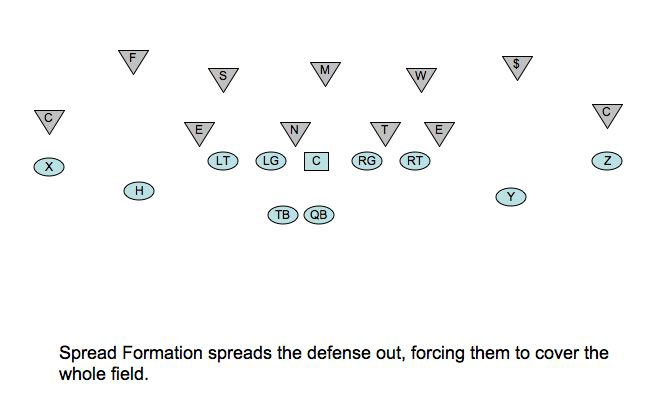
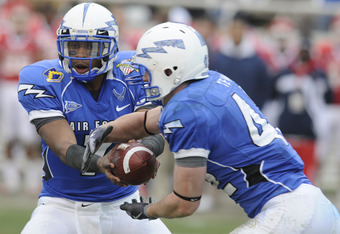
- This is the bread-and butter of any option playbook. It generally occurs out of a Shotgun set (with the running back offset to the side the play is going) or Pistol set (with the runningback directly behind the QB). The linemen block in the direction the play is called, and the running back goes on a dive path (getting ready to run a dive with the QB putting the ball in his stomach). The linemen do not block the last man on the line of scrimmage; this is usually a defensive end or a walked up OLB, and he is considered the READ KEY. If the read key crashes down on the line of scrimmage and pursues the RB, the QB quickly pulls the ball out and attacks the space where the read key just came from. If the read key sits still and plays disciplined, the QB gives the ball the RB.
- Zone option
- This is essentially the same thing as the read option, but now the offensive linemen are taking zone steps (lateral, playside steps, picking up whichever man surfaces first in that area). The running back goes to the direction of the play ACROSS the QB's face (as opposed to straight down into the LOS in the read option) on an outside zone path (attacking the flank and reading how the blocks play out in front of him, waiting for a gap to surface). Meanwhile, the QB reads the defensive end/OLB/read key to the backside of the play, instead of the frontside, like he did in the read option. If the read key to the backside chases after the RB, the QB keeps it and attacks the space where the read key came from. If the read key sits and plays disciplined, the QB hands it off.
- Midline Read Option
- Same as the read option, but now the read key is an interior DL instead of one on the edge.
- Triple Option
- With all of the option types covered so far, we have only had a READ key, giving us two options- either hand the ball or keep it off. For us to have another option, we have to have another key. In the triple option, we have TWO keys- a READ key, and a Pitch key. Typically, in the triple option the pitch key is the next second-level man outside the read key. This can be a rolling down safety, an OLB, or even a corner. The play works the same way as the read option, except when the QB decides to keep it and attack the LOS, he is waiting to see if the first defender to come up covers the QB or the Pitch man. If the defender goes for the Pitch man, the QB keeps it. If the defender goes for the QB, the QB pitches it.
- Wildcat Option
- You do not see the wildcat that frequently anymore, but it was semi-popular in the 2008 season . In the Wildcat, a RB or WR takes the place of the QB, the QB splits out as a WR, and a WR or second RB motions across the formation to make the play look like sweep. The ball is snapped to the RB playing like a QB, and he reads just like a QB would on Zone,
Who Runs it
- Smaller, faster, smarter teams (Regular Option)
- The option game is designed to be quick-hitting and confusing to a defense. Although easy to game-plan for in terms of responsibilities, nothing can truly ensure that the defense will have players in the right spots when they need to be. Also, since good teams do not run an option play EVERY single play, the option is a good follow-up to plays where you have been consistently handing the ball off and attacking the flank or interior of the line.
- An offense has to be intelligent to run the option and have good football IQ. A lot changes in the course of a play, and the OL and blocking backs have to be able to read on the run.
- Some HS, Some College, Some Pro, occasionally. (Wildcat)
- You don't see it that much anymore because most coaches do not like the ideas of lining a QB out wide as a blocker, having a non-QB take and handle a shotgun snap, or wasting practice time to go over something they either will not use or will use very little. The Miami Dolphins did a great job of making the Wildcat a mainstay of their offensive package in 2008, until the Patriots wised up to it in their second meeting and forced them to pass with a sub-par QB.
Hope you learned a little!
Cheers
JG